
It’s October, which means two things; 1) we’ve just launched our brand-new Mind the Gap Survey for 2025, and 2) it’s a key month for highlighting women’s health, with October the awareness month for both breast cancer and menopause. This got us thinking about the opportunity to reflect on how health and wellbeing differ across genders in the workplace.
Our research continues to highlight a persistent truth; the gender gap goes far beyond pay. It influences how employees experience, value and engage with their benefits too.
The satisfaction divide
Our Mind the Gap Survey revealed that men are more satisfied with their employee benefits than women – 63% compared to 55% – which could suggest a deeper issue around relevance, accessibility, communication and expectation.
The difference in satisfaction may be explained by a disconnect in lived experience; in the UK, women typically take on a greater role in caregiving and household management – research by the Office of National Statistics found that women ‘shoulder the responsibility of unpaid work’ taking on an average of 60% more unpaid work than men [1].
Different experiences could also lead to a perception bias; our research shows 43% of men think they receive childcare support compared to 23% of women. This is a notable gap which could be explained by differing perceptions of adequacy due to childcaring requirements; mothers remain more likely to request flexible working hours vs fathers, and spend more time on unpaid childcare [2]. Companies should account for differing expectations and diverse experiences when planning their benefits.
The communication gap
Differing engagement might not just be due to the provision of benefits, but in how they are communicated to employees. In many organisations, support does exist but it’s being underutilised because employees simply don’t know about them or align with the offering available to them.
For example, some employees may not feel represented in how the benefits are being communicated if the leading focus is on benefits that may feel irrelevant or imagery is not inclusive.
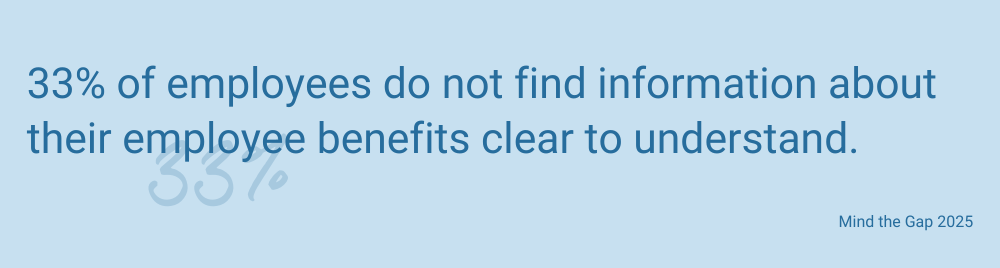
Our research showed that women perceived receiving lower levels of support than men across all key areas such as mental health, physical health and financial wellbeing. Interestingly, women were also less engaged with benefits than men with 37% of women not accessing information about their benefits compared with 27% of men.
This highlights that if communication is happening it isn’t connecting, employers should consider relevance, tone, and accessibility. Benefits communication should take a multi-channel and tailored approach to get the best results.
Spotlight on health
Our research found that women are more likely than men to want more support from their employer with both their physical and mental wellbeing; 29% of women would like more physical health support compared with 27% of men, while 25% of women would like more support with their mental health versus 21% of men.
Combined with lower satisfaction levels, this could suggest that female employees feel as though their current benefits package isn’t meeting their needs. Employers should consider a tailored approach, expanding provision to include fertility, menopause support, childcare provision, and personalised mental health support.
Financial confidence
Financial confidence continues to be one of the largest areas of difference and concern; only 37% of women feel confident they’ll retire with adequate amounts of money, compared to 55% of men. Women are expressing a greater desire for support with their long-term finances, reflecting broader economic trends – women are more likely to work part time [3], with 40% of women taking a career break [4] due to caring responsibilities. Several significant gender pension gaps remain, across contributions, participation, and fund size [5]. Employers should prioritise tailored financial education, accessible advice and workshops to help reduce stigma and target all levels of financial literacy.
Work/Life balance
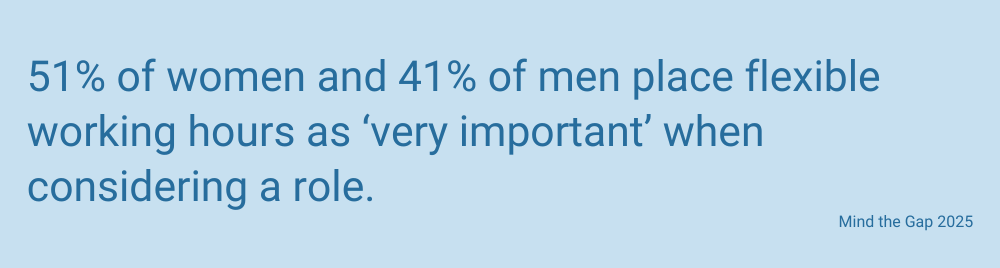
Both men and women identified work/life balance as their biggest struggle. For women this is likely compounded by higher levels of worry around childcare (14%), physical health (28%) and mental health (37%). While men reported highest concern over their physical health. These findings highlight the need for wellbeing strategies that take account of gender, life stage and lifestyle – not just job role or age.
Bridging the gap
The disconnect that we’re seeing throughout our research shows that offering benefits, is a good start but it’s not enough. They must be tailored, visible and truly relevant to the workforce they aim to serve.
Confidence and awareness play a large role; Mind the Gap found that women would be less likely to switch roles for better benefits. Employers need to take a proactive approach to ensure that their benefits strategy recognise differing priorities for the best outcomes.
What can companies do next?
- Tailor your provision: it’s time to move away from a one-size-fits -all approach to benefits
- Bridge the communication gap: review how your benefits are being communicated and ensure messaging is reaching everyone equally
- Gather employee feedback: go beyond satisfaction scores and use surveys, focus groups and employee feedback to understand why needs and perceptions differ between genders

[1] https://www.ons.gov.uk/employmentandlabourmarket/peopleinwork/earningsandworkinghours/articles/womenshouldertheresponsibilityofunpaidwork/2016-11-10
[2] https://www.ons.gov.uk/employmentandlabourmarket/peopleinwork/employmentandemployeetypes/articles/familiesandthelabourmarketengland/2021
[3] https://commonslibrary.parliament.uk/research-briefings/sn06838/
[4] https://www.personneltoday.com/hr/women-forced-into-career-breaks-by-inflexible-work/
[5] https://ifs.org.uk/publications/gender-gap-pension-saving