

Financial wellbeing continues to move firmly up the agenda for most employers, and for good reason. At PIB Employee Benefits, our research highlights a clear gap between what employees need and what they feel they receive from their employer.
The headline figures are striking. More than three-quarters of employees (76%) say they receive no financial support from their employer (excluding pensions) [1]. A further 40% say they simply ‘don’t know’ what financial support is available to them. Even where provision exists, awareness appears limited – with discount portals being the most recognised benefit.
This disconnect presents both a risk and an opportunity for companies.
Financial pressure is affecting performance
Almost three in ten employees (29%) worry about their current finances in a way that is already impacting their productivity at work, and concerns about long‑term finances affect a further 32% [2]. Adding to this, confidence levels appear worryingly low: just 3% of employees describe themselves as ‘very confident’ in their current financial situation. This is not simply a personal challenge; it represents a significant operational risk.
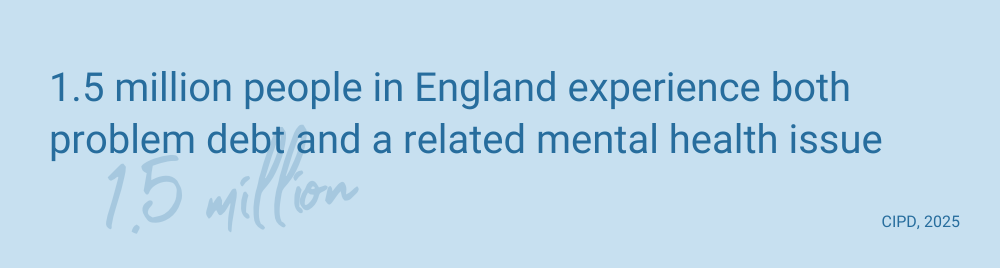
Evidence indicates that financial worries are closely linked to rapidly rising household bills, increased reliance on foodbanks and continued inflationary pressure, with around 1.5 million people in England experiencing both problem debt and a related mental health issue [3].
With ongoing pressures from the cost of living and higher borrowing costs, a growing number of employees are therefore likely to experience financial strain that directly affects their wellbeing and performance at work. As our research shows, when people are preoccupied with money worries, their capacity to focus, collaborate and perform at their best can be significantly reduced.
The long-term confidence gap
The short-term financial pressures faced by employees are only part of the picture. Long-term financial security remains a significant concern, 33% of employees say they want more support with long-term financial planning – yet just 9% report receiving help in this area, making this one of the biggest gaps in provision [2].
More than half (54%) do not feel confident about their retirement outlook and just 4% believe they will retire with ‘plentiful’ money. Adding to this 36% say they do not receive sufficient communications about their retirement savings [2].
This suggests that even though pension schemes are in place, understanding and engagement are falling short. If employees cannot clearly see how today’s contributions translate into their future security, uncertainty and disengagement will become inevitable.
Communication is as important as provision
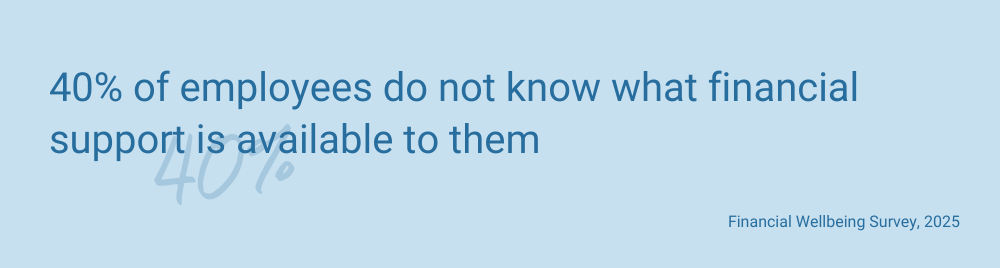
One of the most revealing insights from our research is not just about provision, but perception. When 40% of employees do not know what financial support is available, this issue is as much about communication as it is about benefit design [1].
Financial education, clear signposting and regular engagement campaigns are key. Employers should take a multi-channel approach to communications, keeping them inclusive and accessible. Without this even well-structured benefits risk being overlooked and undervalued.
Employers should ask themselves:
- Are we communicating financial support in plain and accessible language?
- Are we making it easy enough for our workforce to access (for example deskless workers might engage better with breakroom QR codes rather than emails)?
- Are we making long-term planning feel achievable?
Financial wellbeing and mental health
Money worries rarely exist in isolation. Financial stress is one of the most common drivers of poor mental wellbeing; for example, recent UK research shows that almost half of adults (47%) say their mental health has been affected by their financial situation in the last year [4]. Concerns about debt, affordability or retirement adequacy can lead to chronic stress which in turn becomes a key business risk, driving reduced productivity, absenteeism and diminished resilience.
By integrating financial wellbeing into broader wellbeing strategies, alongside mental health support, Employee Assistance Programmes and resilience initiatives, employers can address root causes, not just symptoms.
Closing the gender gap
Our research also highlights a clear gender disparity. Men reported higher levels of financial confidence than women, and financial decision‑making confidence stands at 86% for men and 76% for women [1].
This mirrors wider evidence that women are consistently less confident than men in making financial and investment decisions, even when actual knowledge levels are similar [5].
This gap reinforces the importance of inclusive communication and tailored engagement strategies. Targeted pension awareness campaigns and accessible financial education can help build confidence among underrepresented groups and support more equitable long‑term outcomes.
Turning insight into action
The data tells a consistent story – employees are seeking greater support from their employers, particularly around long-term financial security, yet many are unaware of what is available to them.
Practical steps for employers:
- Strengthening communication around existing benefits
- Providing financial education that is tailored to varying life stages
- Offering retirement modelling and guidance
- Aligning financial wellbeing and mental health strategies
- Reviewing engagement approaches with an inclusion lens
Financial wellbeing is not simply a ‘nice to have’ – with only 3% of employees feeling ‘very confident’ about their financial situation, the risk to productivity, engagement levels and absence levels are real for companies.
Employers who take a proactive approach have an opportunity to move beyond transactional benefits to create a culture that support confidence for both the short and the long-term.

[1] Financial Wellbeing Survey, 2025
[2] Mind the Gap Survey, 2025
[3] https://www.cipd.org/uk/views-and-insights/thought-leadership/insight/action-employee-financial-wellbeing/
[4] https://www.sjp.co.uk/media-centre/latest-news/feeling-the-strain-increasing-financial-stress-takes-its-toll-on-mental-and-physical-health-of
[5] https://www.fca.org.uk/financial-lives/financial-lives-2022-survey