

Rising living costs and economic uncertainty are placing increasing pressure on employees across all sectors, with many looking to their employer for support with their financial (and overall) wellbeing.
At the same time, organisations are competing for skilled people in a challenging labour market, making a strong and well-communicated benefits proposition an important differentiator. Rather than viewing financial wellbeing as a standalone initiative, employers should consider how it complements their wider wellbeing strategy.
When financial, physical and mental wellbeing are supported together, employees are more likely to feel valued and equipped to perform at their best. Financial wellbeing therefore has the potential to strengthen both the employee experience and wider business outcomes.
The Financial Wellbeing Gap
Our Financial Wellbeing Survey 2025 reveals a significant gap between the support employees need and what many currently receive.
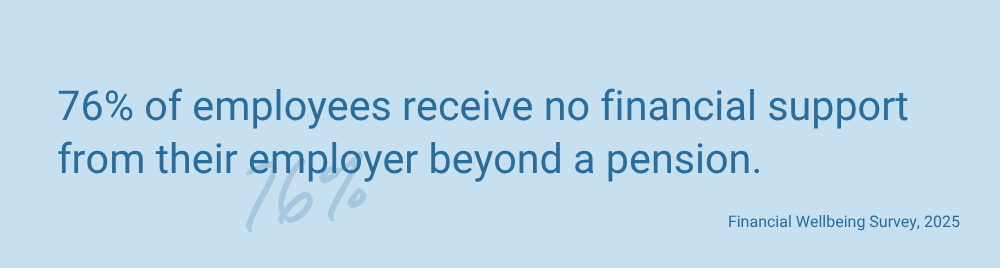
The survey found that 76% of employees receive no financial support from their employer beyond a pension, while a further 5% are unsure about whether any support is available [1].
Despite financial wellbeing becoming a growing priority for organisations, just 11% of employees have access to financial education and only 7% can access budgeting tools through their employer.
These findings suggest that many employers may be overlooking an important opportunity to improve employee wellbeing through relatively simple, practical support. Financial wellbeing does not necessarily require expensive new benefits. Often, it begins with helping employees understand and make better use of the support already available.
Financial Wellbeing is a Business Issue
Financial concerns do not disappear as employees walk through the door. Employees who are worried about money may find it more difficult to concentrate, remain engaged or perform at their best.
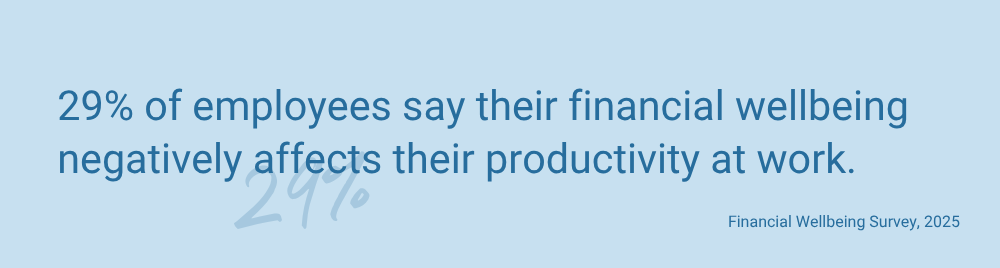
According to our survey, 29% of employees say their financial wellbeing negatively affects their productivity at work, representing a significant operational risk for employers [1]. Over time, financial stress can contribute to increased absence, reduced morale and higher staff turnover. While employees remain ultimately responsible for their own financial decisions, employers are increasingly well placed to provide access to trusted guidance, education and workplace benefits that can make those decisions easier.
Supporting financial wellbeing should be viewed not only as an investment in employees, but also as an investment in organisational performance. For many organisations, this represents a shift in thinking. Financial wellbeing should be embedded within a wider people strategy that supports recruitment, employee engagement, retention and organisational resilience.
A thoughtful financial wellbeing offering demonstrates that an employer understands the real-life challenges affecting its workforce and is committed to supporting employees throughout different stages of their lives and careers.
Looking Beyond the Pension
Pensions remain one of the most valuable workplace benefits, but they are just one part of a much broader financial wellbeing strategy. We found that:
- 27% of employees do not know how much they contribute to their pension each month.
- 18% never check their pension balance.
- 21% only review their pension once a year.
Based on these stats, pension pots are clearly not front of mind in the face of day-to-day pressures. These figures also suggest that many employees need better financial guidance beyond access to a pension scheme.
Importantly, an effective financial wellbeing strategy is rarely built around a single benefit. Employees have different priorities depending on their age, career stage and personal circumstances, so support should reflect those changing needs. A graduate paying off student debt, a parent managing rising household costs and an employee approaching retirement are unlikely to require the same type of support.
An effective financial wellbeing strategy can support employees throughout their financial journey by combining protection, education and practical tools. This may include benefits such as:
- Life assurance
- Income protection
- Critical illness cover
- Health cash plans
- Employee Assistance Programmes that provide access to debt and money guidance.
Employers may also offer financial education, budgeting workshops, payroll savings schemes or access to trusted financial wellbeing platforms. Together, these benefits help employees build financial resilience, both for now and in the future.
Communication Matters Just as Much as the Benefits Themselves
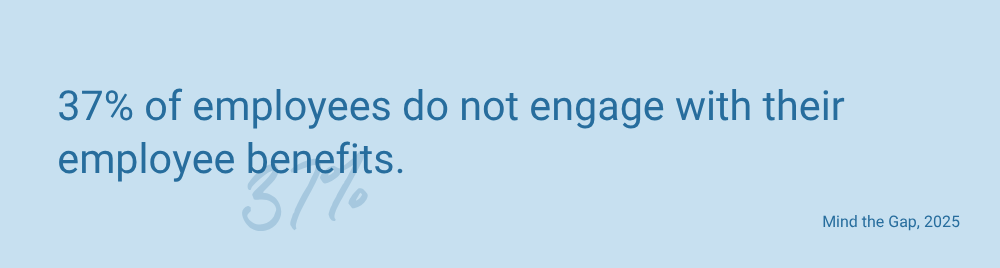
Even the strongest benefits package has limited value if employees do not understand what is available. Our Mind the Gap survey, also undertaken in 2025, found that [2]:
- 37% of employees do not engage with their employee benefits.
- 35% do not understand benefits communications.
- 46% believe they do not receive enough information about the benefits available to them.
This highlights the importance of making financial wellbeing visible throughout the employee experience. Clear communications, personalised total reward statements and easy-to-use benefits technology can all help employees understand the full value of their package.
Platforms that bring together benefits information, educational resources and everyday savings opportunities (such as discount and cashback schemes) can also encourage greater engagement.
In fact, the Financial Wellbeing Survey found that discount portals are currently the most common financial wellbeing benefit – made available to 25% of employees, rising to 44% within larger organisations [1]. While these schemes can provide valuable support with everyday spending, they are likely to have the greatest impact when they form part of a wider financial wellbeing strategy versus being offered in isolation.
Building Confidence, Not Just Resilience
One more encouraging finding from the Financial Wellbeing Survey is that 74% of employees believe they could cover an unexpected £500 expense.
However, short-term resilience does not necessarily mean employees feel financially secure. Only 3% describe themselves as being very confident about their current financial situation, while 40% rate their financial satisfaction at five out of ten or below.
This tells a consistent story: employees are often managing today’s financial pressures while feeling uncertain about tomorrow. Employers have an opportunity to bridge that gap by providing practical support that helps employees understand their finances, make informed decisions and feel more confident about the future.
Turning Insight into Action
Financial wellbeing should not sit alongside an employee benefits strategy; it should be embedded within it. Reviewing existing benefits, improving communication and offering practical financial education are all valuable first steps. Employers should also consider whether employees can easily access support throughout different life stages, from early career budgeting to retirement planning.
As employee expectations continue to evolve, organisations that take a more joined-up approach to financial wellbeing are likely to be better placed to support their people while strengthening engagement and retention.
If you’re reviewing your employee benefits strategy or looking at ways to improve financial wellbeing across your organisation, speaking to an experienced employee benefits adviser can help you understand where the greatest opportunities may lie and how existing benefits can work harder for both your employees and your business. We’d be happy to help – get in touch today.
[1]Financial Wellbeing Survey, 2025
[2] Mind the Gap, 2025