
As we head into 2026, the role of employee benefits has never been more important. Against a backdrop of economic uncertainty, evolving employee expectations and continued pressures on wellbeing, employers are being challenged to rethink not just what benefits they want but how they deliver and communicate them.
Our latest Mind the Gap Survey highlights several key trends shaping employee benefit strategies.
Financial wellbeing moves centre stage
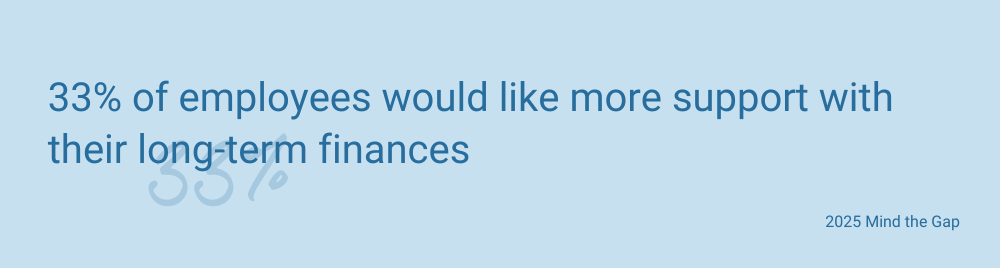
Financial concerns are dominating employee demand for additional support. Our research shows that long-term finances (33%) and current finances (29%) are two of the top areas where employees want more help from their employer.
This reflects a workforce facing rising living costs and long-term retirement uncertainty. Importantly, demand for financial wellbeing support is stronger among female employees than male, highlighting a growing need for inclusive benefit strategies that consider varying financial pressures and life stages.
For employers, this reinforces that financial wellbeing is no longer a nice to have – it is a core pillar of workforce support.
Health and development are key priorities
Alongside financial concerns, employees are also calling for greater support in physical health (28%) and training (28%).
These results underline a growing expectation that employers will invest holistically in their people, supporting not just immediate health needs, but long-term resilience and career progression.
As skill shortages persist, training and development benefits are becoming as important to retention as traditional health offerings.
Benefits influence attraction and retention more than ever
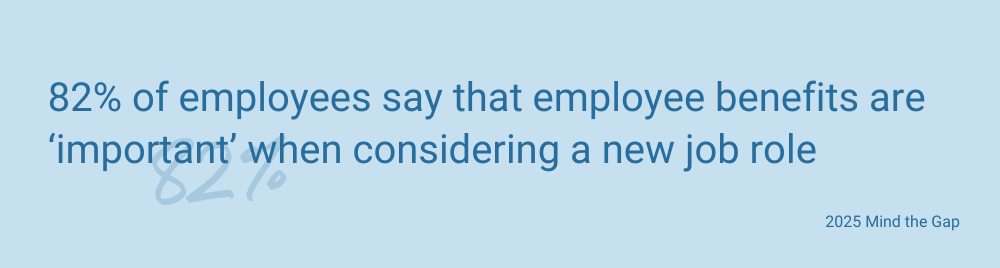
The link between benefits and retention continue to strengthen for the year ahead. Over half of employees (55%) say they would consider leaving their current role for one with better benefits, while 82% state that benefits are an ‘important’ factor when considering a new job.
In a competitive labour market, benefits are no longer a secondary differentiator, they are a deciding factor.
Communication remains a critical gap
Despite the value that employees place on benefits, there is still a clear disconnect when it comes to communicating them.
Only 34% of employees report receiving regular benefits communication that they understand, while 32% say that do not access information about their benefits at all.
Among those who do engage, internal websites (37%) remain the most used channel. In contrast, benefits apps are used by just 17% of employees – raising an important question for 2026, are apps becoming as oversaturated as emails or is simplicity and clarity more important than new technology?
This highlights that effective benefits communication is not about more channels, but about clearer and more relevant messaging that meets employees where they are.
Retirement readiness can’t be ignored
Confidence in retirement outcomes remains worryingly low. Fewer than half of employees feel confident about their retirement outlook and 10% do not believe they’ll ever be able to retire.
As financial pressures extend further into later working life, retirement readiness is becoming a fundamental wellbeing issue for employers. This gives companies the opportunity and responsibility to support employees with education, planning tools and flexible retirement pathways.
Work/life balance and wellbeing pressure persist
When asked where they are struggling most to manage, work/life balance ranked highest (24%), closely followed by personal finance (23%). These pressures are not happening in isolation, employees also report that mental health, long-term financial worries and physical health issues are actively impacting workplace productivity.
This reinforced the need for integrated wellbeing strategies that take a preventative approach, addressing the root causes rather than treating the symptoms.
Demand for choice continues to grow
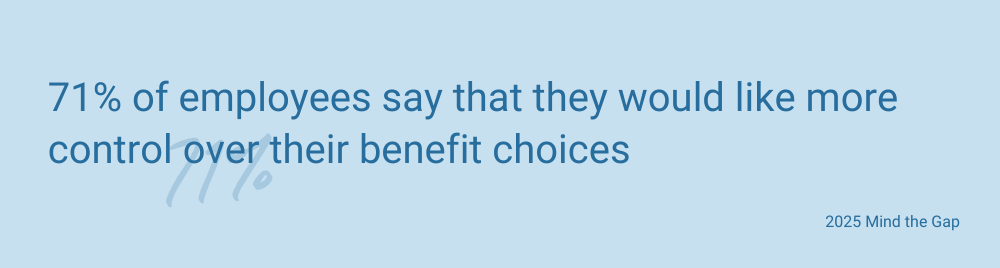
Finally, employees are seeking greater autonomy. 71% of employees say they would like more control over their benefit choices, signalling a clear move towards flexibility and personalisation.
Employees are increasingly expecting more of their employer when it comes to benefits, expecting them to reflect their individual needs and not taking a one-size-fits-all approach.
What companies can do next
The 2026 trends are clear, employees want holistic, personalised support and they value benefits as a core part of their employment decisions.
For employers these trends present both a challenge and an opportunity, the focus should be on closing the gap between benefit provision and how your employees are experiencing them. Those that listen to the needs of their workforce and respond with clarity, relevance and inclusion are best placed to attract and support their people in the year ahead.