
Employee benefits play an important role in attracting and retaining talent, but simply providing benefits does not mean employees understand, value or use them.
This is one of the clearest messages from our latest Mind the Gap research. Our 2026 survey looked beyond benefits provision to explore how employees actually use the support available to them, and where the gaps remain between provision, awareness and take-up.
The results suggest progress in some areas. Almost two-thirds (64%) of employees are now satisfied with their benefits, up from 59% in 2025. However, there is still a significant gap between having benefits on paper and creating a package that makes a meaningful difference to employees.
The Benefits Usage Gap
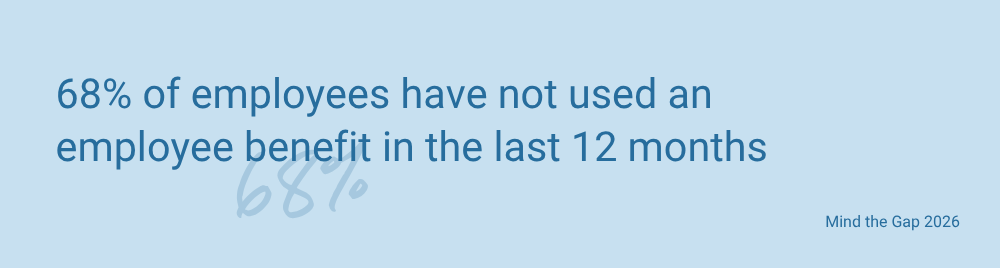
Perhaps the most striking finding is that 68% of employees have not used an employee benefit in the last 12 months, and only one in six have used a benefit to support their health or finances. This creates an important question for employers: are employees choosing not to use their benefits because they do not need them, or because they cannot easily find, understand or access them?
Usage also varies considerably across the workforce. It peaks among 35 to 44-year-olds at 48% but falls to 31% among 45 to 54-year-olds and just 20% among those aged 55+. Sector differences are also clear, with 50% of employees in finance and accounting using at least one benefit, compared with only 20% in transportation and distribution and 18% in real estate.
For employers, this demonstrates why measuring provision alone is not enough. Understanding who is using benefits (and who is not) can provide valuable insight into whether a strategy is working in practice.
Communication Remains a Challenge
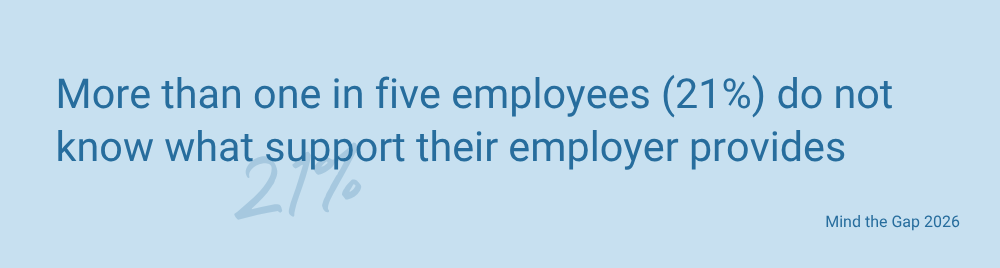
Awareness could be one reason for low usage. More than one in five employees (21%) do not know what support their employer provides, while 32% do not access any information about their benefits. Meanwhile, 43% do not receive regular communication about their benefits.
The problem is particularly noticeable among smaller employers. Only 17% of employees in microbusinesses and 19% in small organisations say they receive regular benefits communications, compared with 70% in large organisations.
Clear, regular communication can help turn benefits from something employees passively receive into something they recognise and value. Rather than relying on annual enrolment periods or occasional emails, employers could consider planned communications throughout the year, using relevant messages to remind different groups about the support available.
Employees Want Financial Security
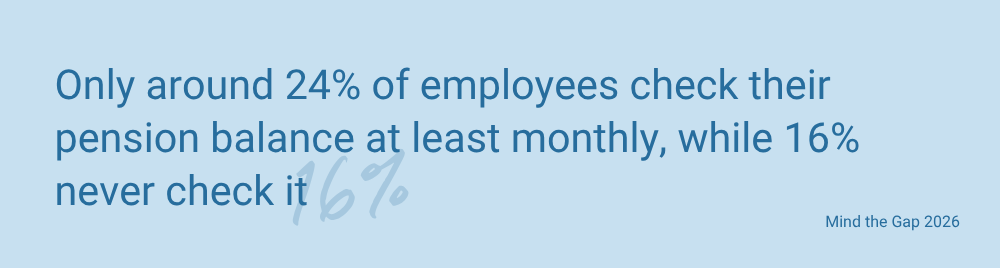
Long-term financial security remains an important priority. Pension contributions rank among the most valued parts of the employment package, yet engagement remains relatively low. Only around 24% of employees check their pension balance at least monthly, while 16% never check it.
Our survey also found that while 34% of employees receive support with their long-term finances, almost the same proportion (33%) would like more. Interestingly, when employees were asked what they would choose if they could trade 1–2% of their salary for one benefit, 34% selected higher employer pension contributions – more than any other option. Yet retirement confidence remains low, with more than half of employees not feeling confident about their outlook.
The appetite for long-term financial security is clearly there. The challenge is helping employees connect today’s pension decisions with their future goals through accessible information, education and regular prompts.
Benefits Matter for Retention
Employee benefits are also becoming increasingly important in the competition for talent. 50% of employees say they would leave their current employer for the same role elsewhere if it came with better benefits. Although down slightly from 2025, it suggests that benefits remain a consistent factor in retention rather than a short-term trend.
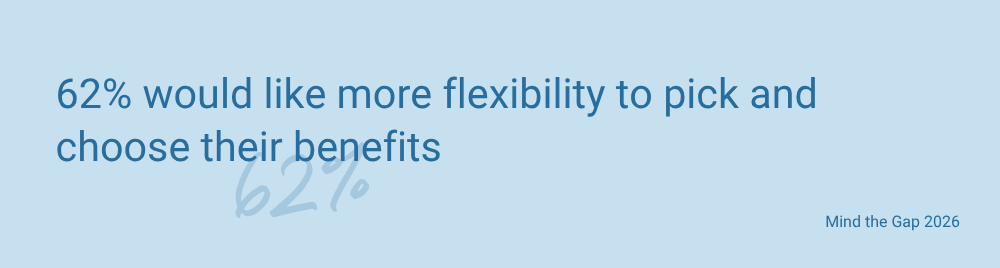
Employees also prefer benefits that reflect their individual circumstances. Mind the Gap 2026 found that 62% would like more flexibility to pick and choose their benefits. For employers, this strengthens the case for regularly reviewing benefits rather than assuming that a long-standing package continues to meet workforce needs.
Smaller Employers Face a Particular Challenge
Organisation size continues to make a significant difference. In 2026, 39% of microbusinesses and 24% of SMEs offer no employee benefits at all. Satisfaction is also lower among micro and small organisations, at 47% and 50% respectively, compared with 74% in large organisations.
Smaller businesses may not be able to match the breadth of benefits offered by large employers. However, an effective strategy is not necessarily about offering more. Understanding what employees value, communicating existing support clearly and focusing investment on benefits that address genuine workforce needs can all make a difference.
Closing the Gap Between Provision and Value
Mind the Gap 2026 demonstrates that the next challenge for employers is not simply expanding benefits provision. It is about tailoring the offering and making sure employees can see, understand and use what is already there.
A useful starting point is to review engagement alongside provision:
- Which benefits are employees using?
- Do any particular groups appear to be disengaged?
- Are communications regular and accessible?
- Does the package reflect the financial, health and caring pressures employees are experiencing?
Benefits technology can also support this process by bringing benefits into one accessible portal, enabling more personalised communications and providing data on what employees value and use.
PIB Employee Benefits can help employers review their current approach and build a benefits strategy that better reflects how people live and work today. Download Mind the Gap 2026 to explore the findings in full or get in touch with our team to discuss how your benefits strategy compares.
*All statistics featured in this article are from our annual research with YouGov, Mind the Gap